Digital Marketing
Last updated: August 2026 RRdigital360 team
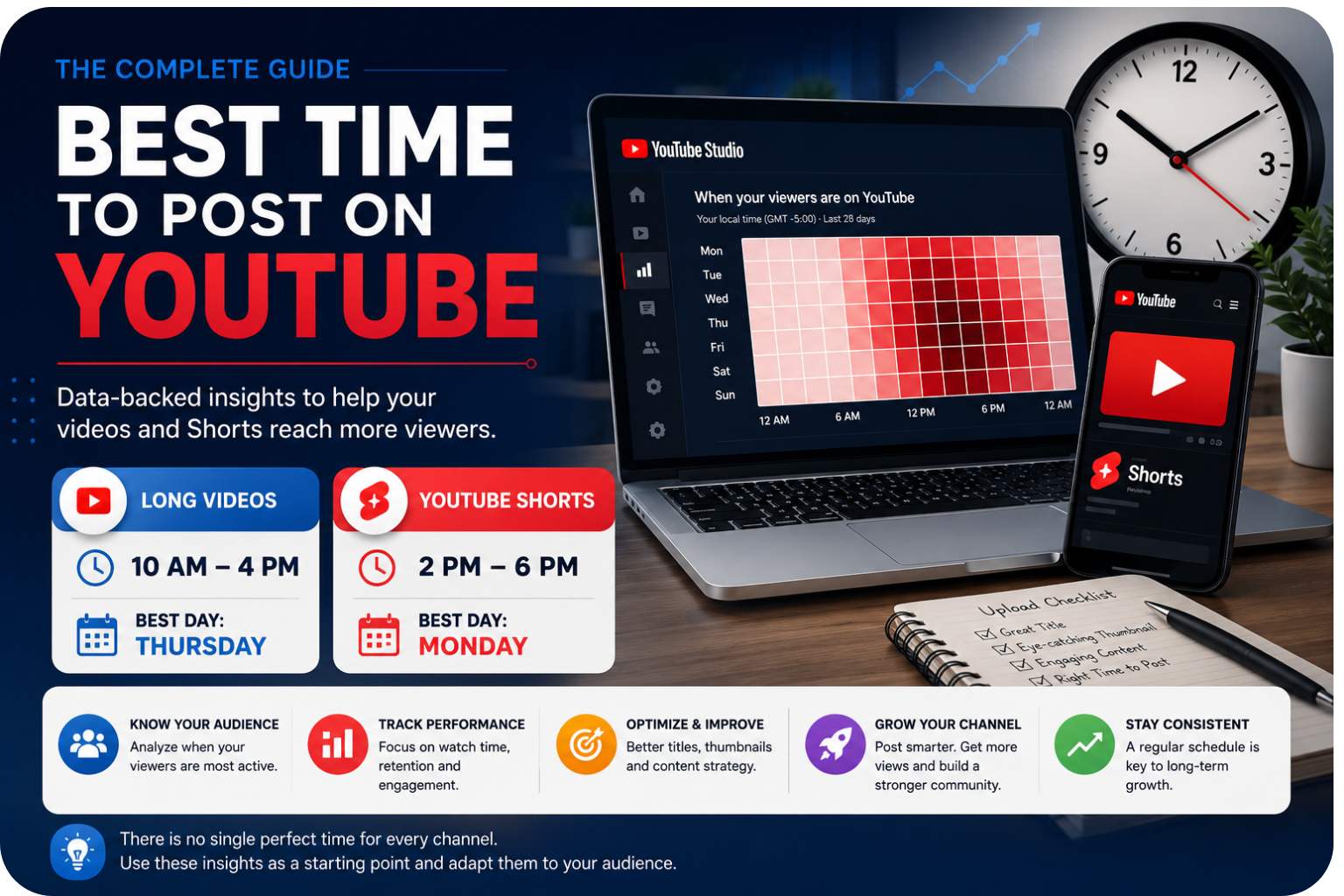
The Best Time to Post on YouTube: A Complete Guide to Better Reach and Engagement
Publishing a great YouTube video is only part of the equation. When you publish it can also influence how quickly your content gains initial visibility, views, and engagement.
But is there really a universal best time to upload a YouTube video?
Not exactly.
The ideal publishing time depends on your audience, content format, location, and viewing habits. Long-form videos and YouTube Shorts can also perform differently because viewers consume each format in different ways.
In this guide, we'll explore the best general times to post on YouTube, explain the difference between long-form videos and Shorts, and show you how to identify the schedule that works best for your own channel.
⏰ What Is the Best Time to Post on YouTube?
Based on the data presented in the original YouTube study referenced for this article, which analyzed 799,718 videos from 71,177 YouTube accounts, publishing activity varies significantly depending on the content format.
As a general starting point:
For YouTube long-form videos
10 AM – 4 PM is the strongest publishing window.
For YouTube Shorts
2 PM – 6 PM is the strongest publishing window.
The strongest days also differ:
- Long-form videos: Thursday
- YouTube Shorts: Monday
These times should not be treated as universal rules. Your own YouTube Analytics data is ultimately more valuable because it reflects the behavior of the people who actually watch your content.
📺 Best Times to Upload Long-Form YouTube Videos
Long-form videos tend to see the highest publishing activity between 10 AM and 4 PM.
The weekday period from Monday through Friday generally provides a stronger starting point than weekends.
However, publishing at the busiest time doesn't automatically guarantee more views.
Your video's:
- Title
- Thumbnail
- Topic
- Audience relevance
- Watch time
- Retention
- Engagement
- Traffic sources
can have a much greater impact on its long-term performance.
A better strategy
Instead of asking:
"What is the perfect time to post on YouTube?"
ask:
"When is my audience most likely to watch my content?"
That small change in perspective can help you develop a much more effective content strategy.
📱 Best Time to Post YouTube Shorts
YouTube Shorts follow a slightly different pattern.
The strongest general publishing window identified in the supplied study is:
2 PM – 6 PM
Short-form videos are often consumed during breaks, commutes, downtime, or after work and school.
This makes afternoon publishing a useful starting point for creators experimenting with Shorts.
However, timing is only one piece of the puzzle.
Shorts depend heavily on:
- Viewer retention
- Replays
- Shares
- Likes and comments
- The strength of the opening seconds
- Audience response
- The ability of the video to maintain attention
The original study also reports that more than 61% of organic Shorts views came from the Shorts feed, highlighting how important the format's distribution system can be.
🎯 Don't Follow Generic Times Blindly
Industry-wide statistics are useful when you're starting out, but your audience isn't the same as everyone else's.
Your viewers may live in:
- Different countries
- Different time zones
- Different age groups
- Different work schedules
- Different lifestyle environments
For example, a gaming channel targeting teenagers may have completely different peak hours from a business channel targeting professionals.
That's why your long-term goal should be to move from general recommendations to personalized publishing data.
📊 How to Find the Best Posting Time for Your Channel
The most reliable approach is to study your own audience.
Inside YouTube Studio, open:
Analytics → Audience
Look for the section showing when your viewers are on YouTube.
The activity chart can help you identify the days and periods when your audience is most active.
Use this information strategically
If your audience is highly active at 7 PM, you don't necessarily have to publish exactly at 7 PM.
You can test publishing slightly earlier so your video has time to process and begin accumulating initial engagement before your audience reaches its peak activity.
Experiment with several time slots and compare the results.
📈 Don't Judge a Video Only by Its Views
One of the biggest mistakes YouTube creators make is focusing exclusively on views.
Views are important, but they don't tell the entire story.
When analyzing your videos, pay attention to:
👀 Views
How many people watched the video?
⏱️ Watch Time
How much total viewing time did the video generate?
📉 Audience Retention
How long did viewers remain engaged?
💬 Engagement
Are people commenting, liking, and sharing?
👥 Subscribers
How many new subscribers did the video generate?
🔎 Traffic Sources
Where did your viewers discover the video?
Together, these metrics give you a much clearer picture of whether your content strategy is working.
🔥 Long Videos and Shorts Need Different Strategies
One of the most important lessons from the supplied data is that long-form content and Shorts shouldn't necessarily share the same publishing schedule.
A simple strategy could look like this:
Content FormatStarting Time WindowLong-form videos10 AM – 4 PMYouTube Shorts2 PM – 6 PMStrongest day for long-formThursdayStrongest day for ShortsMonday
Use these numbers as a testing framework rather than a rigid schedule.
🧠 Study Your Competitors
Your competitors can provide valuable clues about what works within your niche.
Look at channels producing content similar to yours and analyze:
- How frequently they publish
- Which topics receive the most views
- Which videos generate the most comments
- Their titles
- Their thumbnails
- Their video length
- Their use of Shorts
- Their publishing consistency
You don't need to copy them.
Instead, identify patterns.
If several successful channels in your niche repeatedly use a particular format or topic, that's a signal worth investigating.
⏳ Understand the Lifespan of YouTube Content
A video's first few days are important, but they aren't necessarily the end of its journey.
According to the source material used for this article, videos often experience their strongest initial performance during the first three days.
After that, views can decline.
But a successful YouTube video can continue generating traffic for weeks or even months through:
- YouTube Search
- Suggested Videos
- Playlists
- Recommendations
- External traffic
This is why you shouldn't immediately abandon a video because its first few days weren't spectacular.
Sometimes the right audience simply hasn't discovered it yet.
🖼️ Your Thumbnail Can Be More Important Than Your Publishing Time
Imagine publishing at the perfect time.
Your audience is online.
Your video appears in front of them.
But your thumbnail doesn't capture their attention.
They scroll past it.
Timing can't fix a weak presentation.
Your thumbnail should communicate the video's value quickly.
A strong thumbnail should generally be:
- Easy to understand
- Visually distinctive
- Relevant to the video
- Easy to read on mobile
- Consistent with your brand
The same principle applies to your title.
A strong combination of topic + title + thumbnail + timing gives your video a much better starting position.
🚀 Create a Consistent YouTube Publishing Schedule
Consistency is another important part of long-term channel growth.
Instead of publishing randomly whenever you have time, create a realistic schedule.
For example:
Monday: Short
Wednesday: Long-form video
Thursday: Short
Saturday: Community engagement
Your schedule doesn't need to look like this.
The important thing is to create a system you can maintain.
Consistency helps your audience know when to expect new content and gives you more opportunities to learn from your analytics.
🔄 Repurpose Your YouTube Content
You don't have to create completely different content for every social network.
One YouTube video can become multiple pieces of content.
For example:
YouTube video → YouTube Short → Instagram Reel → Instagram Story → Carousel → Blog article
This strategy can help you reach people across different platforms without constantly starting from zero.
For more ideas about creating content that generates engagement, see our guide to <u>the 7 types of social media content that drive engagement</u>.
You can also learn more about <u>how to grow your Instagram followers</u> and turn short-form content into a broader social media growth strategy.
📣 Promote Your YouTube Content Strategically
Publishing your video is only the beginning.
You can increase its exposure by promoting it through your other digital channels.
Consider sharing:
- A teaser on Instagram
- A Short highlighting the best moment
- A Story directing followers to the full video
- A post on your website
- An email notification
- A related blog article
This creates a content ecosystem in which every piece supports another.
And if you're working on improving engagement across your social profiles, <u>effective social media CTAs</u> can help encourage viewers to take the next step.
📊 Build Your YouTube Growth Strategy With RRdigital360
At RRdigital360, we understand that growing a social media presence requires more than simply publishing content.
Your strategy should combine:
Content + Consistency + Engagement + Visibility + Optimization
Our social media growth services are designed to help creators, influencers, brands, and businesses strengthen their digital presence and improve the visibility of their content.
Instead of relying exclusively on one platform, think about your entire social media ecosystem.
YouTube can attract viewers through video.
Instagram can strengthen your community.
Your website can convert that attention into customers.
And strategic social media promotion can help connect all three.
✅ 7 Practical YouTube Publishing Tips
Before you upload your next video, use this checklist:
1. Know your audience
Understand where your viewers live and when they're most active.
2. Separate Shorts from long-form content
Don't automatically use the same publishing schedule.
3. Test different times
Experiment instead of assuming one schedule will always work.
4. Optimize your thumbnail
Make the value of the video immediately obvious.
5. Write stronger titles
Use clear, relevant language that creates curiosity without misleading viewers.
6. Analyze retention
Views alone don't tell you whether people actually enjoyed the video.
7. Stay consistent
A sustainable publishing schedule is more valuable than an unrealistic one.
🏆 Final Thoughts: Timing Matters, But Strategy Matters More
There is no single magic hour that guarantees YouTube success.
The data suggests that 10 AM–4 PM can be a useful starting window for long-form videos, while 2 PM–6 PM can be a useful starting point for Shorts.
But your own audience data should ultimately guide your decisions.
The best YouTube strategy combines the right timing with compelling topics, strong thumbnails, effective titles, audience retention, consistency, and cross-platform promotion.
Start with the recommended time windows, measure your results, and gradually build a publishing schedule based on what your audience actually responds to.
The goal isn't simply to publish at the right time.
It's to publish the right content, for the right audience, at the right time.